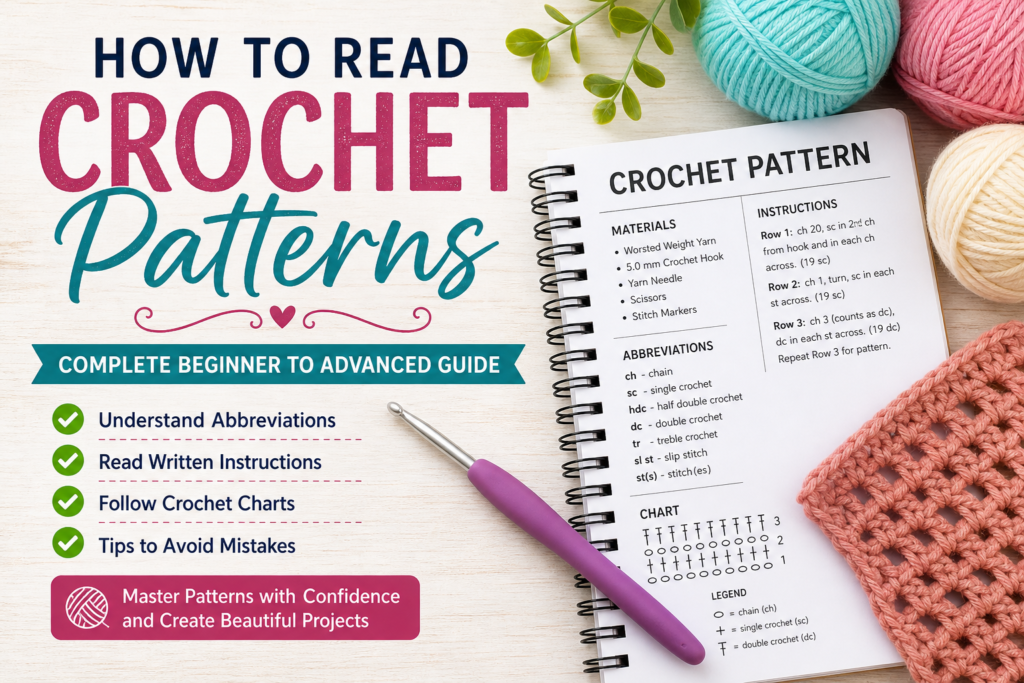
Understanding how to read crochet patterns is one of the most important skills any crocheter will need to learn. Many people feel that crochet is simply a relaxing pastime and are often surprised to learn that patterns can look very daunting at first. Upon closer inspection you’ll see abbreviations, strange symbols, rows and rows of numbers, and instructions written out in detail, which can appear to be a jumbled mess to the inexperienced crocheter. However, once you know how to decipher the various components, you’ll soon find that reading patterns is a breeze.
This guide explains how to read a crochet pattern, understand written crochet instructions and charts. It’s ideal for beginners and for more experienced crocheters who want to be confident in reading patterns and following instructions. It covers everything from simple patterns to more complex designs.
What Is a Crochet Pattern and How Does It Work?
A crochet pattern is a set of instructions which guides the user through the steps to complete a finished crochet project. Reading crochet patterns tells the crofter what materials and techniques are needed to complete an item, following a step-by-step guide to help you to master even the most complex of crochet designs. Firstly, we need to learn how to read the pattern using recognised abbreviations and following the unique construction of crochet designs.
Craft patterns can be written or charted, or both combined. Written patterns describe each sequence of stitches and charts show the stitches using symbols. Both patterns may look unfamiliar at first, but once you learn the basics, you can soon be reading them with ease, whether written or charted.
Why Understanding Crochet Patterns Is Essential
Most beginners start out with tutorials however there is so much more to explore when you learn how to read crochet patterns. Patterns open up thousands of possibilities including scarves, hats, sweaters, Blankets and so much more. Being able to read patterns will allow you to make any project you wish and adjust it to fit your personal style.
Recognising patterns will also aid in maintaining the correct stitch count, garment size and overall design. This in turn can save time by decreasing the chances of error and allowing crocheters to work more efficiently, as clearly written patterns enable them to offered a greater depth of understanding into what each row of work is forming. This in turn can give the crofter great freedom of expression and open up new and exciting possibilities in crochet.
Basic Structure of a Crochet Pattern Explained
It may be helpful to read through the beginning of the pattern before following the tutorial, as you will see the layout of the pattern and what to expect. Almost every crocheted pattern follows a similar format, so being familiar with what parts make up a regular pattern makes it much easier to follow along with tutorials.
Pattern Title and Description
The title will tell you what you are making, such as a scarf, blanket or sweater. The description will provide more details on what the pattern makes, the skill level, finished measurements and style of the garment. When learning how to read crochet patterns, read this section carefully so that you know what to expect before you start.
Materials and Tools
This section lists the materials needed for the hat, including the type of yarn and recommended hook size, as well as any additional supplies that may be required, such as stitch markers or tapestry needles. Try to use the materials listed here to get the correct sized finished hat with the intended texture.
Gauge Information
Gauge is the number of stitches and rows (measured in whatever unit you prefer – I like to use 4 inch squares) that a pattern expects your work to be, and it is crucial for making sure that whatever you’re making turns out the size you want it to. Many new crocheters ignore the gauge when they’re learning to read a pattern, but when you’re making something that is going to fit a person, like boots or a sweater, you want to make sure that you understand the gauge.
Abbreviations and Terms
At the heart of every crochet pattern are the abbreviations used throughout. These standard short forms for common crochet terms are what enable patterns to be brief and clear and to make following the stitches easy for crocheters. Every pattern uses the same patterns abbreviations; in this tutorial we will go through each one, explaining what each one means.
Common Crochet Abbreviations and Their Meaning
Short cuts: One of the main difficulties beginners face is being able to understand the many abbreviations that are used in crochet patterns. If you feel that you don’t fully understand the different abbreviations, you may find it helpful to check them out in a crochet dictionary or on the Internet.
Know your stitches! For example, “sc” stands for single crochet and “dc” for double crochet. Also, don’t forget “ch” for chain and “sl st” for slip stitch. These abbreviations are the key to reading crochet patterns, and are the building blocks for all crocheters to learn.
Language is important when crochet patterns are concerned. Different countries have different ways of expressing same actions. So if you are crocheting from a US pattern it will be different from UK terms. For example, US terms refer to this stitch as a double crochet, whilst UK patterns would refer to it as dc. Before you start make sure you know which terms are being used in your crochet pattern.
How to Read Crochet Pattern Instructions Step by Step
Once you have learned the crochet abbreviations, learn to read crochet patterns line by line. Typically crochet patterns are written following a logical sequence. Each row is built upon the row before it.
For example, an instruction might read: “Ch 20; sc in 2nd ch from hook and in each st across—19 sc.” My mistake- 20 chains to start, then hook in second chain from hook and single crochet. Repeat to end of row, for a total of 19 single crochets in this row. When first beginning a pattern, it helps to break down each step individually. If a pattern reads “Start with twenty chains to the hook. Work in single crochets to end of row” it means you first make twenty chains, then hook in second chain from hook and make one single crochet. Then repeat across until you have completed nineteen single crochets.
Understanding Repeats, Brackets, and Stitch Counts
In many crochet patterns certain parts of the pattern are repeated and written simply to save time explaining it all out. These repeated sections of patterns are usually indicated with brackets < >, parentheses ( ), or asterisks * *. For example: “(sc, ch 1) repeat across” Repeat from * one single crochet in each stitch, one chain between; being familiar with these indicators is essential when learning how to read crochet patterns. For this pattern they are: (sc, ch) repeated across the row.
I will often record the stitch count at the end of a row in (parentheses). This can assist weaver in confirming whether or not they are on the correct row should stitch count not agree.
How to Read a Crochet Pattern Chart
Not all crochet patterns will include written directions. Many patterns are written in charts that can be helpful to both inexperienced crocheters and the most seasoned pro. Reading crochet pattern charts can be especially helpful for visual crocheters who understand a project better by seeing it.
Every symbol on a crochet chart represents a particular stitch or combination of stitches: for example, a dot could be a chain and a “T” could be a double crochet. Also, charts are generally read from bottom to top for straight patterns and from right to left for round patterns. So, learning charts will add another level of ability to read crochet patterns — the visual.
Difference Between Rows and Rounds in Patterns
First, you need to learn how to read a crochet pattern, which generally begins with a statement as to whether the pattern is worked in rows (where you turn at the end of each row of work) or rounds (where you work continuously from start to finish, usually following with instructions on how to begin). Patterns that are worked in rows are usually easy to pick up and generally used for scarves, blankets, afghans, and other flat items. Projects that are worked in the round are commonly hats, amigurumi, and other circular shaped projects.
The pattern will indicate whether you need to turn your work or continue right on. Please make sure you are understanding the correct shape and size of your garment, as misinterpreting the pattern can alter the finished garment into the wrong configuration.
Tips to Master Reading Crochet Patterns Faster
Reading patterns takes practice, but there are a few ways that it can be made less frustrating. First, read the entire pattern before beginning, so that you will know what to expect, and then read it again as you work, paying special attention to any areas that may cause confusion.
Remember a list of abbreviations until you memorize them. Practice simple patterns before attempting the more complicated projects. The more you practice reading crochet patterns, the faster and more confident you will become.
Common Mistakes Beginners Make
While beginner crocheters may have different tendencies when first learning to read crochet patterns, there are a few common slip ups that happen to most of us at one time or another. For example, many of us overlook crucial sections like gauge, misuse abbreviations, or fail to count stitches.
Remember that rushing through instructions, not fully comprehending the steps and mistakes, occurs. Take your time and crochet slowly and deliberately as you follow through the pattern and work.
Advanced Tips for Reading Complex Patterns
Once you feel comfortable working with basic crochet stitches and patterns, it’s time to advance to more complex patterns that incorporate multiple stitches, color changes, and increases and decreases. Working with an advanced pattern requires a good understanding of how to read a crochet pattern.
The pattern is broken down into manageable steps with each row illustrated in detail to help you understand each instruction. Important sections can also be highlighted for easier reference and you can mark your progress along the way by highlighting or underlining the relevant text and diagrams. With a little practice you’ll soon master the most intricate of designs.
Conclusion
Understanding how to read crochet patterns is important to every crocheter. With this single skill you will be able to create everything from an Afghan to a Zebra hat. I know it can look mind-boggling to a new crocheter, but once you get the hang of it, reading patterns becomes second nature, especially if you practice and understand the key elements involved in reading a pattern.
Getting to grips with reading crochet patterns, recognising abbreviations and practicing from written words and charts will soon have you crochet-ready and ready to learn new stitches. With time and practice, reading patterns becomes second nature allowing you to focus on the fabric, texture and colour and getting the most out of your crochet.